Introduction
What is this? This toolkit was created to support youth-focused community violence intervention (CVI) programs in starting or strengthening their efforts to measure impact whether for internal learning, program improvement, or research. The toolkit was designed with input from both CVI practitioners and academic researchers in Washington state as part of a collaborative effort to co-develop youth-focused evaluation measures for specific CVI programs in the state. It reflects the real-world needs of CVI teams involved in the collaboration and the diverse communities they serve. The toolkit is not meant to be prescriptive or necessarily generalizable. Rather, it is a shared resource that we invite you to tailor and build upon. The platform lets users choose what they want to measure, explore both quantitative and qualitative questions, and build custom surveys or interview guides tailored to their work.
Why do we need it? Many surveys used in research were not designed or validated for communities of color, often missing the cultural and structural realities of those most impacted by violence. For CVI programs, which often serve Black, Latinx, Indigenous, and other historically marginalized groups, standard evaluation methods can misrepresent outcomes and fail to capture community strengths and needs. This gap reflects a broader history of underinvestment in violence prevention and the exclusion of community voices in research. By centering the people doing the work and living the realities, we can redefine what success looks like and create evaluations that are more accurate, respectful, and rooted in equity.
Theory of Change
In general, a theory of change (TOC) can be thought of like a recipe that outlines the current situation, intervention (actions taken to change the current situation), and desired outcomes (results of actions taken to change the current situation).
This toolkit is guided by a specific TOC previously co-developed through a collaboration between FIPRP and several CVI programs in Washington state. The TOC outlines how CVI programs involved in the collaboration aim to address social and structural factors that contribute to violence. It included six key domains: (1) root causes of community violence, (2) promotive factors (assets and resources that currently exist or need bolstering), (3) activities (services and supports provided by the intervention), (4) intermediate outcomes (6 months to 1 year), (5) longer-term outcomes (1-2+ years), and (6) multilevel context (external factors related to youth/families, staff/organizations, community, and society that affect CVI programs).
We focused on co-developing evaluation measures for intermediate and longer-term outcomes in the TOC, but included several other measures related to context and activities.
The TOC is designed as a flexible and holistic framework that recognizes that CVI programs work in diverse settings with different populations but may often have similar fundamental strategies and goals. The TOC provides a common lens to conceptualize, compare, and evaluate CVI programs, while offering flexibility for and honoring differences. As such, while the TOC was co-developed for specific CVI programs in Washington state, it may provide a shared foundation for understanding, evaluating, and adapting strategies across varied community contexts.
Toolkit Creation
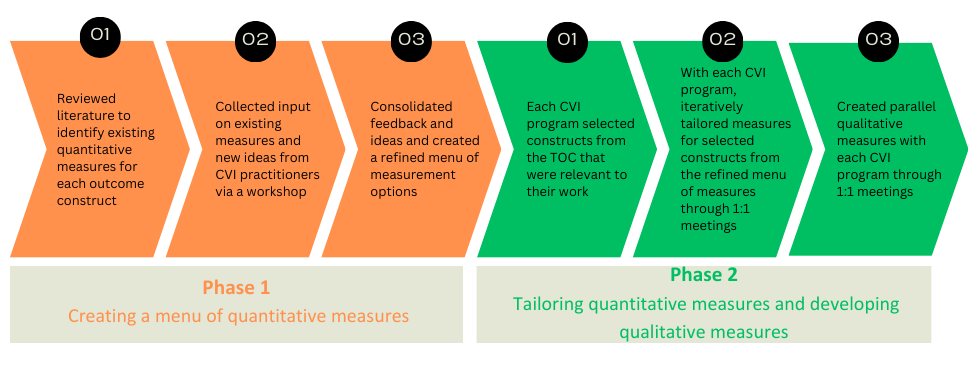
Evaluation measures were developed through a two-phase, collaborative process (see figure below). In Phase 1, the academic team curated a menu of quantitative measures (i.e., survey questions) by integrating existing literature with insights and new ideas from CVI practitioners. In Phase 2, each CVI program involved in the project selected constructs from the TOC that were relevant to their work and collaborated with the academic team in 1:1 meetings to tailor measures for those constructs (from the menu created in Phase 1) to their program and service population — ensuring clarity, relevance, and alignment with program needs. Qualitative measures (i.e., interview guides) were co-developed in parallel to complement the survey questions. This online toolkit draws from the inventory of the finalized, tailored measures.